

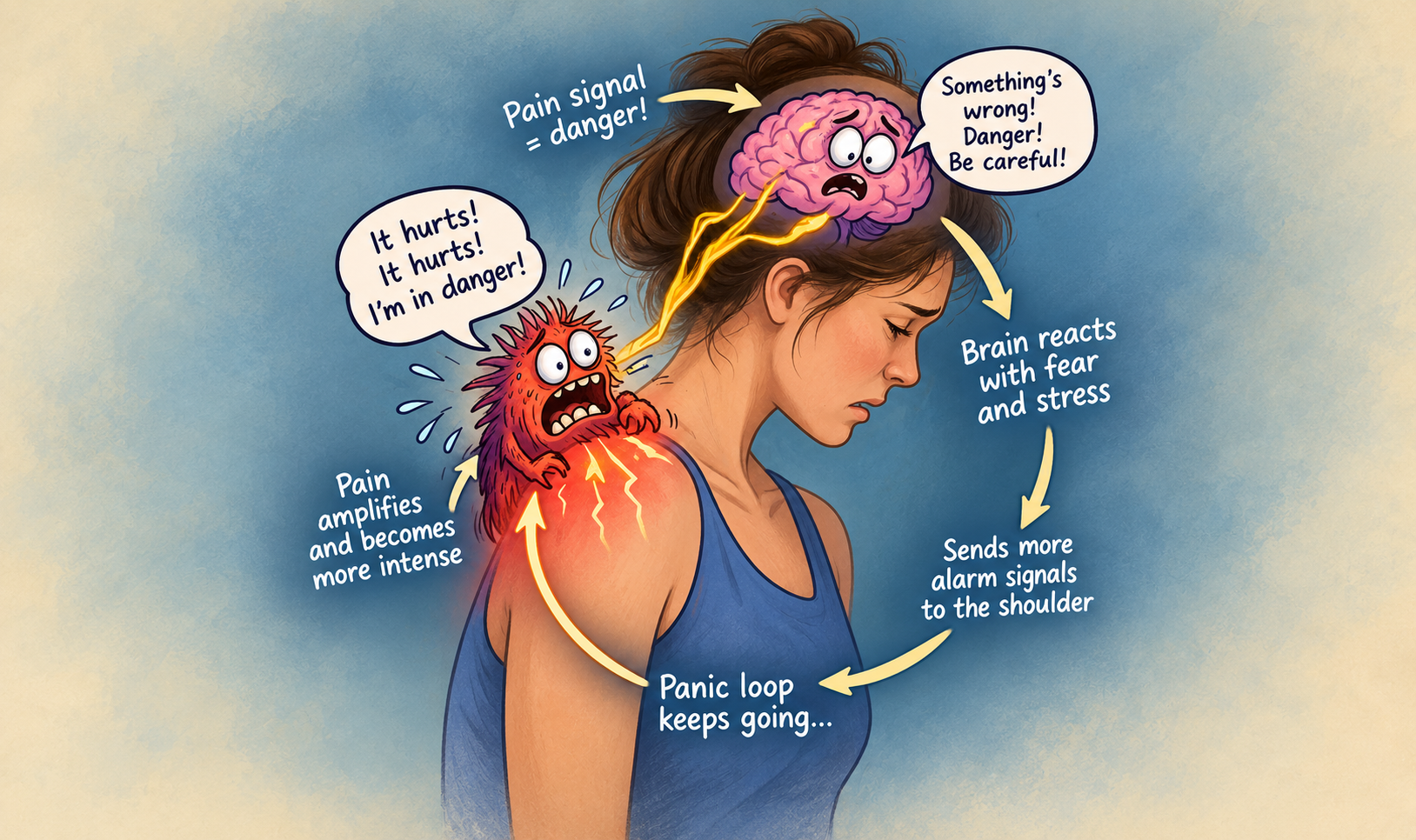
When Protection Becomes Pain
Did you know that chronic pain may not be a mistake of the body, but a brilliant attempt to protect you?
Millions of people live with chronic pain and cannot find lasting relief through conventional medical treatments. Persistent headaches, back pain, joint pain, and other symptoms can gradually take over a person’s life, affecting sleep, movement, work, relationships, and sense of wellbeing. Over time, people can become exhausted, frustrated, and afraid that they will have to live with the pain forever. Perhaps we need to change the way we understand pain in order to address it more successfully.
My Own Experience with Pain
Five years ago, I began having severe shoulder pain. My left shoulder started hurting first. I am not quite sure what triggered it. I may have pushed it a little too hard during a downwind paddle. There was pain, but I could still function. Then, after a particularly intense physical therapy session, my shoulder completely froze. It stayed that way for almost a year. A few months later, after a minor fall from a horse, my right shoulder developed an inflamed bursa. Suddenly, both shoulders were in pain. The pain became so significant that I had to put my active Maui lifestyle on hold. For four years, I couldn’t do watersports, nor swim or bike, not even practice yoga. Treating my own clients became increasingly difficult, and my nights were miserable. I couldn’t find a comfortable sleeping position anymore. My life seemed to be falling apart. I became increasingly frustrated and worried that I might never find my way out of it. I was seriously considering leaving Maui for good.
I was open to almost anything that might help. I was fortunate to work with some excellent practitioners and tried physical therapy, acupuncture, shiatsu, osteopathy, chiropractic treatment, TENS units, steroid injections, PRP injections, Feldenkrais, psychic readings and even painkillers. The first steroid injection helped one shoulder temporarily. The PRP injections, on the other hand, caused a tremendous amount of additional pain. But despite all these treatments, my pain persisted. The harder I tried to fix my body, the worse I seemed to get. I was trapped in a cycle of disappointment and fear.
At one point, I went to see a doctor and asked for blood tests. Surely, I thought, there must be something fundamentally wrong with me. I also expected that new MRIs would finally give me an explanation. If I was hurting this much, there had to be something visible that accounted for the severity of my symptoms. But my blood work was normal, and the MRI did not provide the answers I was looking for. Nothing seemed to explain why I was experiencing so much pain.
If My Tissues Weren’t Severely Damaged, Why Was I in So Much Pain?
In fact, my radiologist told me that he hadn’t seen shoulders that looked this good in a long time. There were some moderate rotator cuff tears, but some of the more significant tears were actually in the shoulder that hurt less. Surgery was considered optional and wasn’t recommended by the surgeon. And yet the pain was very real. It was affecting me every day. A wrong movement – like reaching for a cup – could cause an excruciating pain and bring me to tears.
An Unexpected Discovery
Then, unexpectedly, I experienced something that completely changed the way I thought about pain. I was in Denver taking a training in the treatment of concussions and traumatic brain injuries. We were working with the brain, exploring with our hands how it processes information coming from the body.
During a demonstration of “Functional Listening to the Brain”, something remarkable happened. Within about 15 minutes, my arm suddenly had significantly more range of motion and was able to lift it almost free of pain. The shoulder pain I had been struggling with was about 90 percent better!
I was in tears. I could hardly believe it. After almost four years of pain and countless treatments, how was it possible that working with my brain could change my pain so quickly? This experience gave me something I hadn’t had before: a different way of understanding pain.
And I want to make one thing very clear: The pain had never been “just in my head.” It was real. I felt it every day, and it had profoundly affected my life. But I began to understand that the fact that pain is real does not necessarily mean that the source of the pain is ongoing tissue damage.
Pain is More than a Signal from Injured Tissue
When we sustain an acute injury, pain is extremely useful. Pain protects us. If the nervous system detects a potential threat, the brain produces pain to encourage us to protect the injured area while it heals. In this sense, pain is not the enemy. It is part of an intelligent protective system. But more pain does not necessarily mean more damage. Sometimes the nervous system remains protective even after the original injury has healed.
The brain can learn that particular movements, sensations, situations, or emotions are associated with danger. It begins to predict: “This might not be safe.” Once that association becomes strong, the nervous system may continue producing pain even when the original threat is no longer present.
This is where neuroplasticity becomes important.
The Brain Learns, and Sometimes It Learns Pain
The brain is constantly receiving enormous amounts of information. To make sense of all of it, it has to make rapid predictions based on what it has experienced before. This is sometimes described as predictive processing.
I experienced a funny example of this while driving through a forest in Washington this month. I caught quick glimpses of dark animal shapes along the roadside. The first time, my brain interpreted the shape as a black baby cow. The next time, I thought I had seen a boar. But I actually saw my first two bears. Then later that day, I saw a large dark dog—and my brain immediately told me it was a bear. My brain was learning quickly from limited information. It was trying to predict what I was seeing before I had enough information to know for certain.
That same nervous system may learn that a particular movement, emotional experience or sensation means danger. The same basic ability that allows the brain to learn, adapt, and compensate can sometimes become overprotective. And if it repeatedly interprets that same sensation as threatening, the pathway can become strong, increasingly sensitive and can create a self-perpetuating cycle:
Sensation → Fear → increased protection → more pain → more fear → more pain.
We become afraid of the pain and afraid that it will never go away. That fear itself becomes additional information for the brain that something is wrong. In the end the pain can become part of the danger signal.
Neuroplastic Pain
One of my chronic pain clients introduced me to Alan Gordon’s book The Way Out. Other clinicians and researchers have also challenged the traditional way of thinking about chronic pain. John Sarno explored the mind-body connection decades ago, encouraging patients to reconsider the source of their pain rather than focusing only on medication or injections. Howard Schubiner and others have continued researching the relationship between the brain, emotions, and chronic pain and collected a lot of scientific evidence for role of the brain in chronic pain.
A classic example is the English construction worker who jumped from a scaffolding and landed on a nail, that penetrated his shoe. He experienced overwhelming pain and was taken to the hospital. But when his boot was removed, the doctors discovered that the nail had passed between his toes without even injuring his skin. His pain was completely real – his brain had simply interpreted the situation as a tremendous threat.
This is an important reminder that pain is not a direct measurement of tissue damage. The brain is constantly interpreting information and deciding what requires protection.
And because the brain can learn these protective responses, there is another possibility that gives us hope: What the brain has learned can sometimes be unlearned.
Moving from Fear Toward Safety
Ignoring pain, pretending it isn’t there, pushing through it, or simply telling yourself to “think positively” is unlikely to change the pain very much. Instead, the sensation can be approached with curiosity rather than fear. You can begin to notice the sensation, the emotions, the images, the thoughts, and the expectations that accompany it. Rather than immediately interpreting the sensation as evidence of damage or danger, you can begin feeding the nervous system new information. It means creating enough safety for the nervous system to discover that it may no longer need the same level of protection. Over time, the brain may arrive at a different conclusion:
“This sensation may be uncomfortable, but it isn’t necessarily dangerous.”
“I can experience this and be safe.”
Scientific research done by physicians like Sarno, Gordon, Schubiner and colleagues is showing promising results and supports the efficiency of their holistic approach.
Where This Connects with My Work
In my practice, I often see people whose pain has become much more complex than the original injury. Fear and anticipation can become part of the pattern. Muscles tighten, movement patterns change, the body adapts, the nervous system becomes increasingly protective. Structural problems are real, and they should not simply be dismissed. But it gets more and more evident, that the brain and nervous system are not just passive observers of pain. They are active participants in the experience of it.
As a classically trained homeopath, I learned early on in my education how important it is to explore medical history, accidents, injuries, emotional experiences, possible triggers, and patterns that may have shaped the way the client’s body responds. I want to understand not only where someone hurts, but also what has happened in their life.
In my sessions I use a combination of tools—palpation, touch, visualization, mobilization, awareness, and intuition—to help the nervous system experience something different and recognize safety. I believe that gentle touch is an important part of the healing journey and makes it easier for the brain to change unhealthy neurological circuits.
The goal is not to tell the body that the pain isn’t real. The goal is to help it discover that it may no longer need to protect itself in the same way. When I look back at my own chronic pain, I can now see how many factors may have contributed to an overprotective nervous system. My pain was inconsistent and sometimes triggered by emotional stress. On top of that, I had experienced a serious concussion during a life-threatening drowning incident in big waves. My brain had experienced a great deal of danger and had plenty of reason to keep trying to protect me.
Is Your Pain Trying to Protect You?
Maybe it is time to start looking beyond the place that hurts—and explore the connection between your brain, nervous system, body, and pain. It is fascinating what can become possible when we learn to understand the language of our body and recognize its capacity to heal. When we meet the body with compassion and trust, we can create the safety it needs to let go of patterns it no longer needs.
Perhaps your chronic pain can become part of your medical history sooner than you ever imagined.
Howard Schubiner / Kate Murphy: Unlearn Your Pain: The Science of Recovering from Chronic Pain, Fatigue, Anxiety and Depression. 2026
Alan Gordon / Alon Ziv: The Way Out: A revolutionary, Scientifically Proven Approach to Healing Chronic Pain. 2022
John E. Sarno: The Mindbody Prescription: Healing the Body, Healing the Pain. 1999



When Back Pain Isn’t Really About the Back
Struggling with severe low back pain or herniated discs? Learn how a holistic approach can offer las

Concussions: More Than Just a Bump on the Head
Concussions are complex injuries that affect the brain, the entire body, and emotional well-being. T

Listening Hands: Symptoms Are Messages, Not Mistakes
Symptoms are rarely the problem, they're the body's way of adapting. Learn how "diagnostic touch" lo